In August and September, Phage Foundry joined teams with the Phage Pathways team at San Francisco State University to provide two hands-on workshops for the 2025 Phage Pathways cohort.
Phage Pathways, also funded by the U.S. Department of Energy, provides undergraduate and graduate students in Microbiology and Cell & Molecular Biology at San Francisco State University (SFSU) and San Diego State University) with collaborative, immersive research experiences with co-investigators at the University of California, Davis and DOE National Laboratories—Sandia National Laboratories (SNL) and Lawrence Berkeley National Laboratory (LBNL). (Students from collaborator Skyline College also participate in program offerings.) The first, 2025 cohort is composed of 25 students.
Phage Foundry co-investigator, Archana Anand (SFSU), leads as PI of the Phage Pathways project, and Phage Foundry PI Vivek Mutalik (LBNL) and co-investigators Simon Roux (LBNL, JGI) and Catherine (Katie) Mageeney (SNL), are Phage Pathways co-investigators.
Phage Discovery Workshop: A Week of Hands-on Learning
By Sona Garsevanyan, Phage Pathways Program Manager, SFSU
In mid-August, Isabella Murray and Madeline Svab, undergraduate students from PI Vivek Mutalik’s lab at LBNL, led the Phage Pathways cohort through a five-day Phage Discovery Workshop at SFSU.
The workshop immersed participants in the fascinating world of bacteriophages, providing practical training in phage isolation and exposure to core methodologies in phage research.
Over the course of the week, students learned how to:
- Culture and enrich bacteria
- Filter the enrichment
- Isolate phages from environmental samples
- Scale up phages
- Perform plaque assays to visualize viral activity
- Explore phage-host interactions and their ecological significance
- Extract DNA
Many participants were working with phages for the very first time, and the lab was filled with curiosity, excitement, and plenty of “aha!” moments.
The success of this workshop reflects the power of peer-led training. Isabella and Madeline not only shared technical skills, but also their own journeys as researchers, inspiring our cohort to see themselves as future contributors to this fast-growing field. With their help, our cohort quickly applied their knowledge in critical thinking about phage applications in health, agriculture, and biotechnology. The cohort presented their group projects during the incubation waiting periods, leading to a highly engaging and successful workshop.
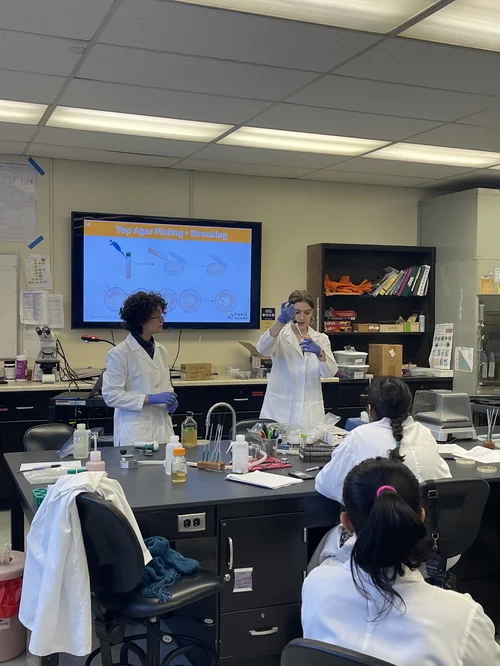
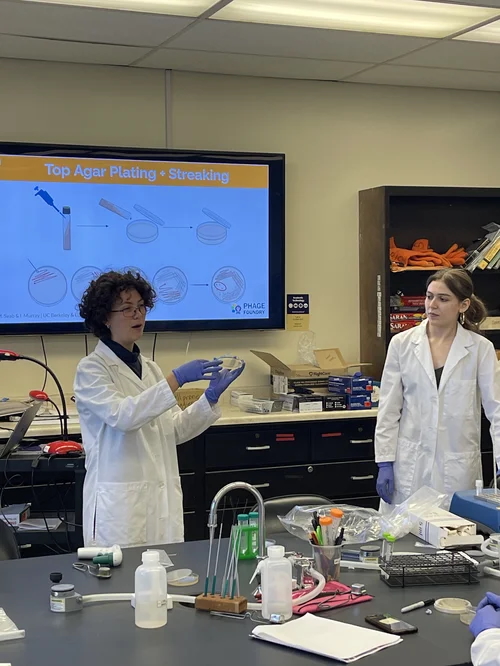
Isabella Murray (left, both images) and Madeline Svab (right, both images), undergraduate student researchers at the Mutalik Lab at LBNL, led the five-day Phage Discovery Workshop at SFSU.
Exploring Viral Informatics: IMG/M-ER Workshop at The Joint Genome Institute
By Sona Garsevanyan, Phage Pathways Program Manager, SFSU
In September, the Phage Pathways cohort visited the DOE Joint Genome Institute (JGI) at LBNL for a hands-on workshop on IMG/M-ER (Integrated Microbial Genomes & Microbiomes Expert Review system). The sessions were led by Simon Roux (Phage Foundry co-investigator), Natalia Ivanova, and Rekha Seshadri, researchers at JGI who brought their expertise in viral informatics, microbial genomics, and functional annotation to the classroom.
Over the course of the workshop, participants were introduced to:
- Navigating the IMG/M-ER platform for microbial and viral genome analysis
- Exploring microbial community datasets to uncover functional potential
- Annotating genes, comparing genomes, and applying bioinformatics pipelines to real-world environmental data
This was the first in-depth exposure to large-scale microbial data analysis for many in the Phage Pathways cohort. The workshop bridged the gap between benchwork and computation, showing how genomic tools can reveal hidden patterns in microbial and viral communities.
The opportunity to interact directly with the scientists driving these research tools forward made this workshop especially impactful for the Phage Pathways team. Simon, Natalia, and Rekha shared not just technical know-how, but also insights into how computational methods are transforming microbiology—whether in environmental systems, human health, or biotechnology.
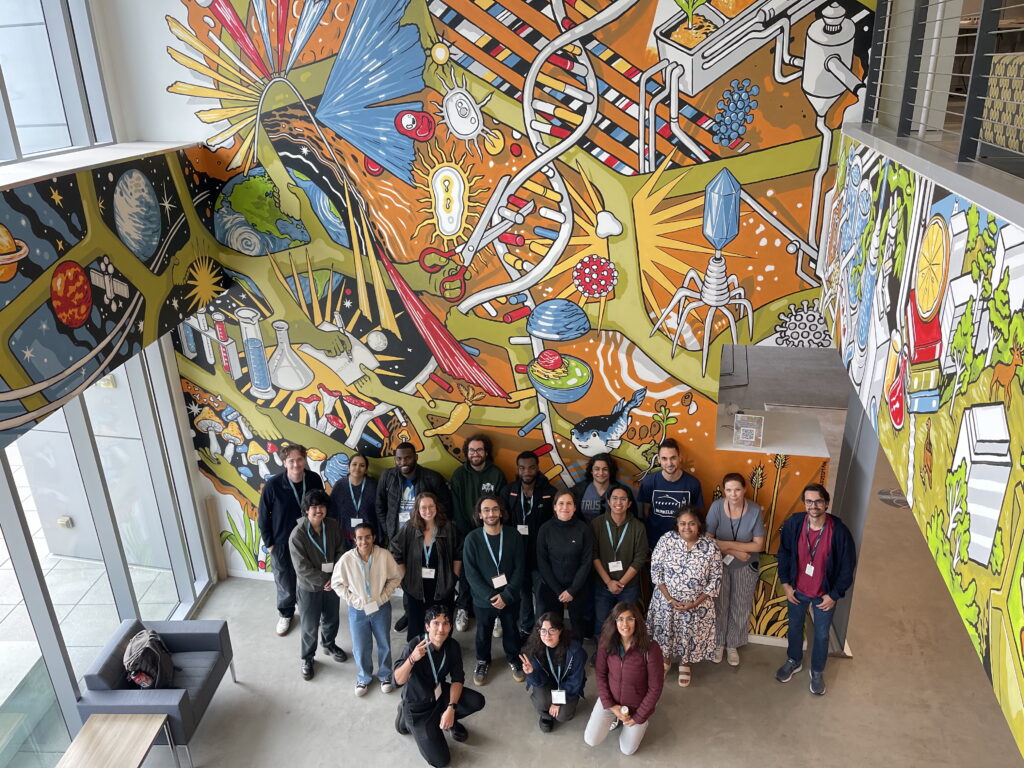
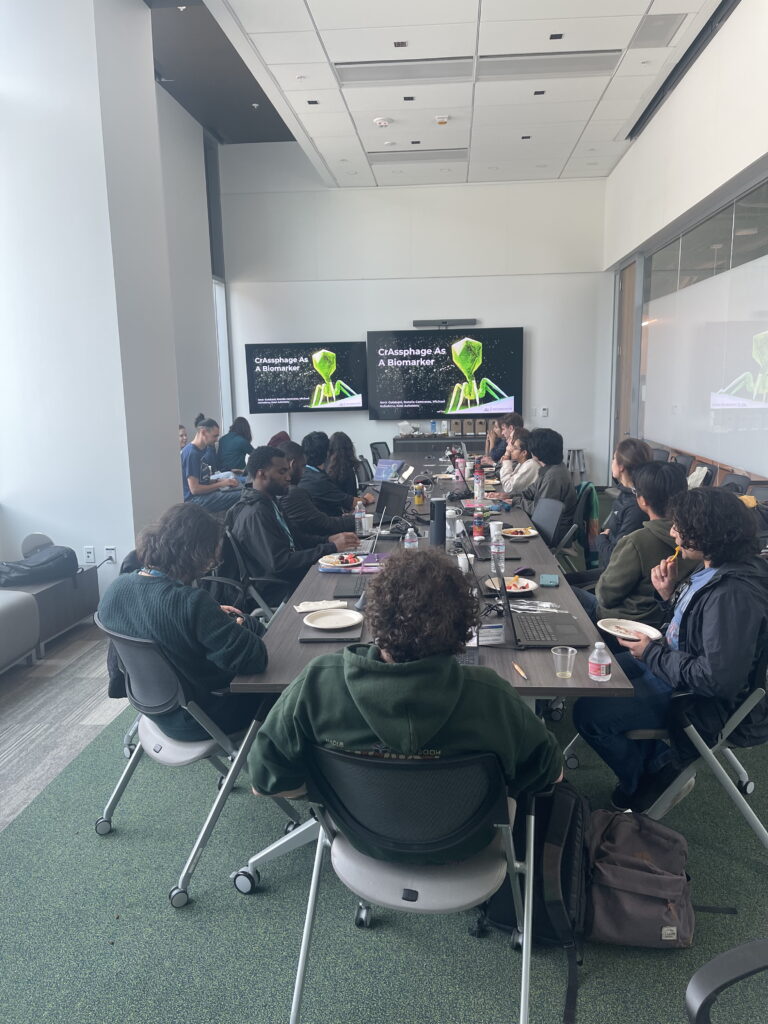
The event reinforced a key message—modern microbiology is powered by data as much as by experiments and learning to work across both is essential for the next generation of scientists.
Thank you to the Phage Pathways team and cohort for two fantastic collaborations!